

Climate change is here. Anyone who has lived through the umpteen heat waves in the UK and Europe this year knows that we are not just living through an ‘unusually hot summer’. Even businesses can feel the pain.
In its annual climate barometer survey, Germany’s KfW bank asked 800,000 German businesses about the impact climate change has on their businesses. The full report is only available in German (or rather, I could only find it in German), but the key results are available in English here.
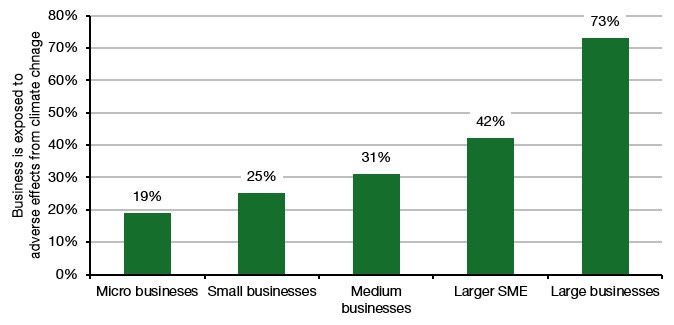
And the thing I found most interesting is not so much the headline result that 21% of German companies in the survey said that climate change already creates an adverse impact on their business. Rather, it is the big gap between large and small/micro businesses.
Is your business exposed to adverse effects from climate change?
Source: KfW
Only 19% of micro businesses (with less than five employees) say they feel the adverse effects from climate change, but 73% of large businesses (with more than €500m in turnover) say so.
I don’t know what drives this massive difference. The authors of the research note say it is because large companies operate globally and thus may be impacted by adverse climate effects in regions like Asia or Africa. I would add that smaller businesses often don’t have the resources to assess the impact of climate change on their businesses. For example, retail stores may see lower footfall during a heatwave, but they will not attribute that directly to climate change because all they care about is the revenue at the end of the month. Yes, revenues may have dropped, but they fluctuate anyway every month, and who has the time to analyse what exactly caused that drop?
The report indicates that the damage from climate change is likely to be much higher than the cost of abatement and adaptation. Yet, the difficulty is that the loss of revenue is an opportunity cost, but adapting to climate change comes at a cost. And especially smaller businesses often don’t have the necessary cash reserves to invest in these measures.
Indeed, the costs of climate investments are mentioned as the most important obstacle to adaptation. In essence, many smaller businesses face a trade-off: Invest in climate change adaptation and risk going bankrupt quickly or don’t invest and risk going bankrupt slowly.
What a cheerless way to start the week.
The essential point of the article is in the last paragraph. Whilst the study was about German businesses, the effects are global.
There will be little progress on this existential threat to humanity until we have overcome the plausibility of denial, and the global acceptance of responsibility to manage our resources with a view to the long term.
Unfortunately we homos are not built to prioritise the long term over the immediate,nor the global over the parochial, nor to eschew today's luxuries over tomorrows misfortunes.
The smaller and younger a company is, the more fragile and concerned with day to day firefighting. It is proportionally larger businesses that are consistently cash flow positive that have the luxury of time to consider the longer term.
Have a good week
is this the same group of small biz owners that would not be convinced that pandemics are real, were it not for zero customers? 'direct-to-cash' has the type of impact politicians cannot change with narrative.
whereas climate change can still be called 'weather'.