

I like to joke that the last job that will be replaced by AI is stand-up comedian. The idea behind it is that AI (at least in its current form of large language models) is not creative. All it can do is look back at stuff that has already been produced by humans and apply it to solve a question in a probabilistic manner.
The problem seems, though, that most people are apparently completely fine with simply rehashing the results of previously created genuine human creativity into a bland, mediocre piece of pseudo-art. Case in point: AI music.
In 2025, we had reports that a purely artificial AI band managed to rack up one million streams on Spotify. Then, in the second half of the year, large music companies entered commercial deals with AI music generators like Suno to use existing artist catalogues.
I guess that was unavoidable given the quality of AI-generated music these days and the commercial opportunities. And music executives are not in the music business, mind you. They are in the business of making money, no matter whether that undermines quality or even the ability to make money in the distant future. If there is money to be made in the next one to three years, music executives will happily throw artists under the bus to keep their shareholders happy.
The problem with AI music is not the technology itself, though. I have seen the enemy, and it is us.
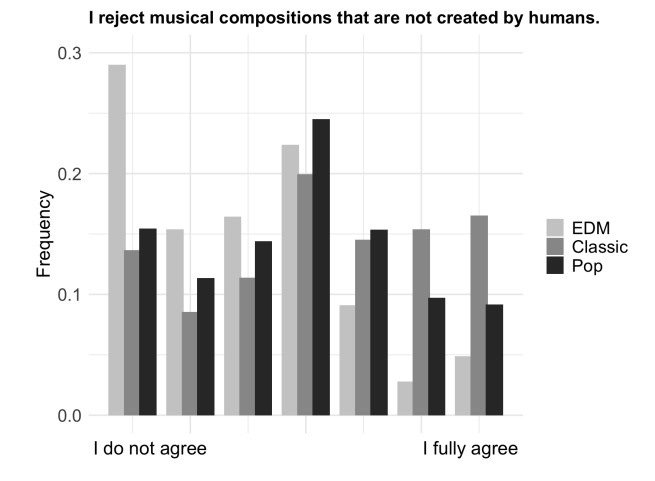
A team of researchers in Germany recruited thousands of participants to test the perception of listeners of AI-generated music. In their first experiment, they asked more than 2,000 participants how they felt about AI-generated music and whether they rejected it or not. The chart below shows the responses split by preferred music genre.
Attitudes towards music not created by humans
Source: Friedrichsen et al. (2026). EDM = Electronic Dance Music.
The chart shows some differences between people who enjoy different genres of music. Fans of classical music are more likely to reject music that is not generated by a human, while fans of electronic dance music are more open to it. But the differences tend to be small and are not statistically significant.
Which leaves us with only one result. The most likely attitude of consumers to AI-generated music is an emphatic: Meh. They are neither actively embracing it nor actively rejecting it. They mostly don’t care.
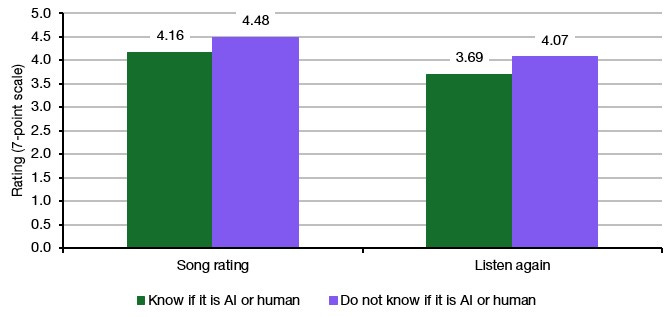
Of course, this is a hypothetical question, so in a follow-up study, the researchers asked 425 participants to listen to a playlist of songs. One-half of the participants were shown a playlist that consisted of songs created by unknown human artists. In contrast, the other half were shown a playlist that explicitly stated that the music was generated with the help of AI. Of course, the songs were identical in both conditions, but the perception of how much people liked the songs changed.
The chart below shows on the left that when participants were informed that a song was created with the help of AI, they liked the song less. Similarly, they were less likely to listen to the song again if they knew it was created with the help of AI.
How knowing music is generated by AI changes perception
Source: Friedrichsen et al. (2026).
However, what happens when people don’t know that music is generated by AI and are being asked to listen to a couple of songs, some of which are AI-generated, others are composed and recorded by a human?
The 1,248 participants in the third study could not distinguish between AI-generated and human-made music. The quality of the AI-generated music is simply too good and will fool all but the most sensitive listeners.
And if people aren’t made aware that they are listening to AI-generated music, they found the AI-generated compositions slightly preferable. On average, listeners were a bit more willing to listen to an AI-generated song again than to a human-made song. And when asked about how much the listeners would pay for a song, there was zero difference in the willingness to pay for AI-generated and human-made songs.
What these results show is that music executives have a strong incentive to generate more AI music and hide that it is made with the help of AI. This way, they can generate the same or even higher revenue streams for the company because the willingness to listen to these songs is slightly higher (and I am sure with a little bit of practice, one can come up with ‘addictive’ AI songs). Meanwhile, the costs are lower because one doesn’t have to pay pesky musicians and deal with their constant demands.
End result: higher profits for the music industry but much less money for real musicians.
My reading of this article tells me that music composers ( in all and every genre) face even worse prospects than musicians.
Full disclosure, my wife is a professional musician (and I have a vested interest in keeping her employed).
I don't buy it, and I'd recommend a look at what Ted Gioia (also at Substack) has been writing about the subject.
Record sales are down, because the "industry' is not promoting new artists. Instead, it's buying up Classic Rock and other genres, and promoting them through biopics. Flogging a dead horse, so to speak. Soon, they'll be promoting AI "artists"; anybody want to bet on the success of flogging a robot horse?
Live music, in contrast, is more popular than ever. Superficial experiments declare that folks like Slop Music. In reality, it's just the industry grasping at diminishing returns, because it can't be bothered to do the real work.
I'd also recommend looking at the conflict between Danny Sapko (old school) and Mahiney Dey (sell-out to AI) as an early indicator of what actual fans, i.e. people who are willing to spend money on music think. They hate, hate, hate slop.