

It is well-known that nationalising businesses or entire industries does not work. It may be necessary in a crisis, like Sweden did in the aftermath of its housing bubble in the early 1990s (an important lesson in how to deal with a financial crisis that was forgotten by 2008), but in general, the government should keep its hands out of running businesses.
Yet, we are once again in an age when governments in several countries are openly discussing the potential nationalisation of underperforming businesses. A new study might act as a cautionary tale here.
When Chile selected the left-wing President Salvador Allende in 1970, his government launched one of the largest nationalisation programmes ever seen in a democracy. The new study reconstructed the financial data of 71 large firms in Chile between 1967 and 1973, 32 of which were nationalised. The charts below show the difference in profitability (return on assets, ROA) and sales over assets between nationalised firms and firms that remained in private hands. On average, nationalised firms saw their profitability drop by 11-13% and their sales over assets by 20% in the years after nationalisation.
Impact of nationalisation on firm performance
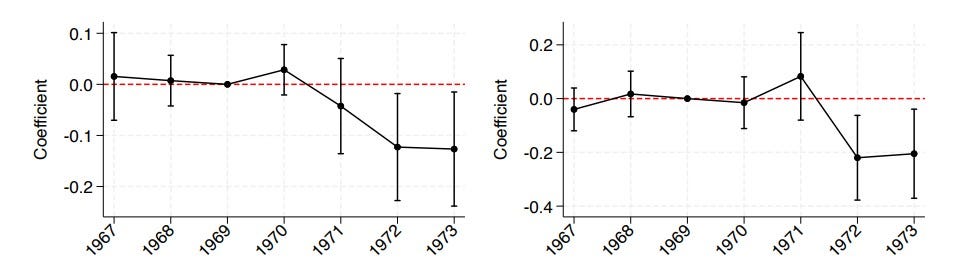
Source: Gonzalez and Prem (2026)
None of this is surprising. Study after study shows that nationalisations don’t work, except in extreme circumstances like a crisis, when the government has to act as an ‘investor of last resort’ in strategically important businesses.
But what I found interesting is that this kind of populist approach isn’t even a vote winner. In the municipal elections of 1973, the governing coalition lost between 1% and 4% of the vote share in those municipalities that were exposed to nationalised factories and firms. And these losses were not compensated by vote gains in other areas.
So, nationalisation of businesses is bad for the economy, bad for the people and, as a result, bad for the politicians who initiate them. Quite simple, really, yet a lesson that gets forgotten time and again.
Not to bash you as I like much of the stuff you write about but one random example like this is not a good backing.
In Switzerland where absolutely everything works so well, the approach is a mixed model. Key utilities and national transportation are publicly owned.
Some are partly corporatised, the key ones aren't.
I'd appreciate an assessment across a basket of countries. I'm also sure cultural elements have a big part to play in whether a nationalised company works or not.
We have a brand new experiment.
Putin is nazionaliting every firm that doesn't fit his drone-prove standards.