

When I talk to retail investors, I am surprised by how often I hear claims that investing in a green fund or green stocks reduces greenhouse gas emissions. Newsflash: It doesn’t. ESG investing reduces the risk of an investment being caught in a scandal or an environmental accident, etc., but it does nothing to incentivise a company to reduce its greenhouse gas emissions, for example. For that, engagement is needed, and retail investors simply don’t have the leverage to influence corporate decisions.
But there is one group of companies that seems to benefit from the misguided belief among retail investors that ESG investments help reduce greenhouse gas emissions: asset management firms offering ESG funds.
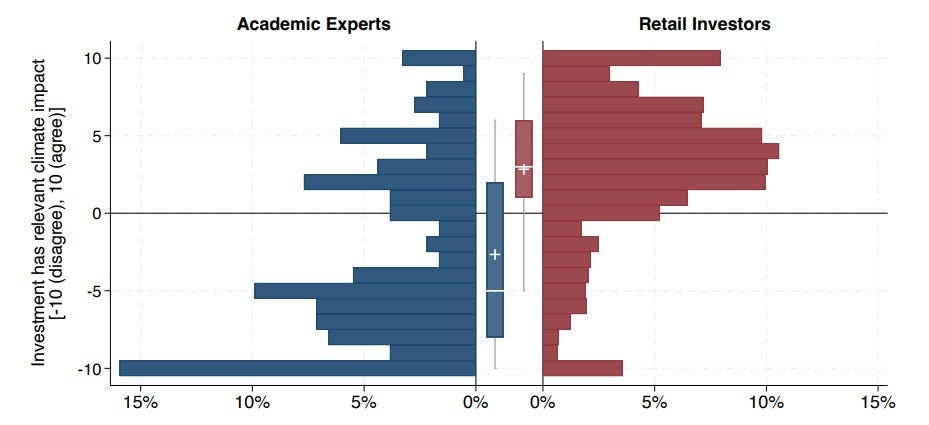
Florian Heeb, Julian Kölbel, and Camilla Weder surveyed 189 academics and more than 2,000 retail investors in Germany about their beliefs on ESG investments and green funds. The basic disagreement between experts and retail investors is shown in the chart below, which shows how many respondents agree or disagree with the statement that “investing €10,000 for ten years in a green fund makes a relevant contribution to reducing global greenhouse gas emissions”. Most retail investors think so, while most academics disagree.
Do investments in green funds reduce greenhouse gas emissions?
Source: Heeb et al. (2025)
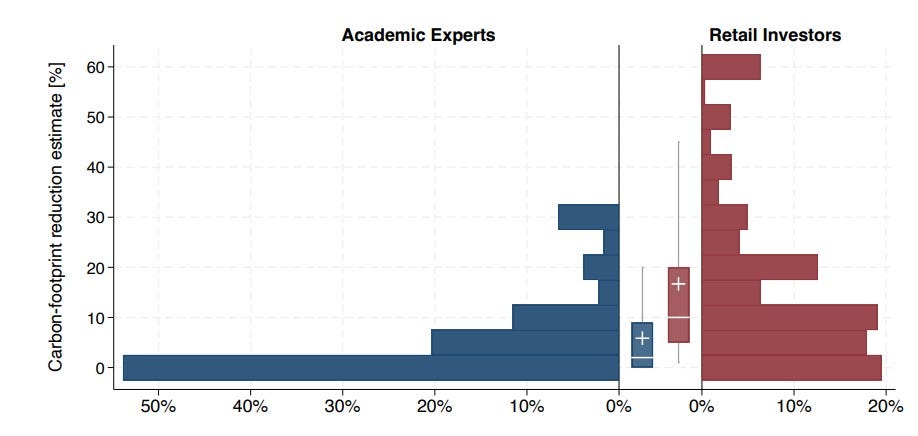
Indeed, if you ask experts and retail investors how much a €10,000 investment in a green fund offsets the average German’s greenhouse gas footprint, most academic experts say zero, with the average expectation a 2% offset or less. Meanwhile, the average retail investor expects that such an investment would offset his or her greenhouse gas emissions by about 10%.
How much does an investment in green funds offset personal greenhouse gas emissions?
Source: Heeb et al. (2025)
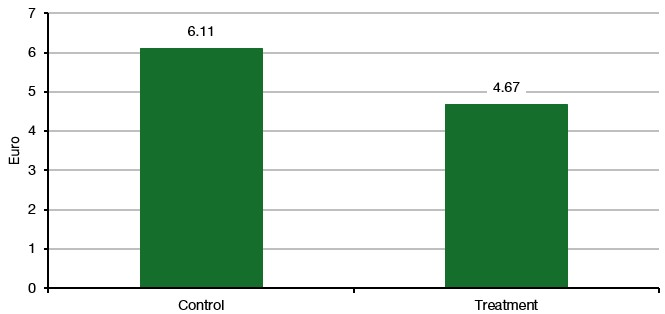
Of course, one could educate the public about the lack of impact of investment in the average green fund. But I guess fund managers will not be leading the charge on that one. When the researchers informed retail investors about the true impact of their investment in green funds, the willingness to pay for a green fund declined significantly. They were still willing to pay more for a green fund than a conventional fund, and when given the choice, 55% of retail investors would still choose the green fund rather than the conventional fund, but the premium they are willing to pay for a green fund shrinks by about a quarter.
Willingness to pay for a green fund
Source: Heeb et al. (2025)
'investing €10,000 for ten years in a green fund makes a relevant contribution to reducing global greenhouse gas emissions”. Most retail investors think so, while most academics disagree.'
Who says the retail investros aren't academics? Thinking of the social classes who invest and those that don't it's safe to say the retail investors are academics who don't study ESG impact. And media rather prefers to not write about anything but orthodoxy.
The academics who lead NL institutional investor APG (601 B invested, clients are a.o. the Netherlands largest p fund ABP - gov workers, education, military etc 533 B invested) have divested from half of their companies for reasons of moral excellence (climate, weapons, DEI). The NL national bank would like to have them increase passive investments but their moral stance has increased their active portfolio. (The underwhelming results of NL p funds has been a topic for many years now).
'In 2022, the extra return on actively managed investments was minus 0.11 percentage points.
In 2023: minus 1.08 percentage points.
In 2024: minus 1.23 percentage points.
In 2025: minus 3.02 percentage points.
In all these years, the extra return on the entire investment portfolio was also negative. In the meantime, the Director of Asset Management at APG has left with a ‘termination payment’ of €1,013,719. The payment also serves as a silencer; that is how things work in the highest circles of the business world.'
'“APG’s return on its investments was negative last year: namely minus 1.6 percent. That is a loss of 9.7 billion euros.” Tamminga presents a simple alternative alongside this: a stable savings interest rate of approximately 1.1 percent, which, conservatively calculated, means a rough 16.4 billion euros in revenue has been missed. He warns: more than two-thirds of pension payouts come from investment returns, not from contributions.'
A debate one year ago between the very academic head economist of Triodos bank, where the NL neat middle classes can confess of their excellent moral instincts, and ABN AMRO's former head economist and climate - and energy realist Han De Jong:
'Stegeman argues that sustainable investing would be better not only for the world, but also for pensions. He writes that financial markets do not adequately price in some long-term risks, such as the risk of 'stranded assets' at oil companies (oil reserves and installations that would eventually become worthless), climate risks, and the risks of biodiversity loss.'
'The 'market' is the collective intellect of hundreds of millions of investors. You really have to be very sure of yourself if you believe that they are seeing things wrong and you are not. Every investor can familiarize themselves with the narrative regarding 'stranded assets' and take this into account when forming a stock price. Why would those millions of investors be wrong and Stegeman not?
Incidentally, Stegeman's stance implies that the expected stranded assets cannot be a reason for the unconditional exclusion of fossil fuel companies. After all, it is also possible that the market is exaggerating the risk of stranded assets. According to Stegeman's logic, you should actually hold them in a heavily weighted portfolio in that case, but I suspect he will never advocate that.
All academic literature known to me shows that the cost of capital of companies excluded by sustainable investors does not rise, which is the intention. Exclusions are therefore totally ineffective. However, many funds have extremely long lists of excluded companies, which can also vary significantly from fund to fund.
Stegeman further writes that 'risks are non-linear, complex, and fundamentally uncertain'. Therefore, the standard view is that investors must diversify. According to Stegeman, that is precisely what you should not do. He advocates selectivity, because 'the only thing you do know regarding the long term is where the risk hotspots lie'. Here, Stegeman seems to claim that he can accurately assess risks, despite their fundamental uncertainty. Unlike others, apparently.
It boils down to the fact that Stegeman reasons from a belief, a rock-solid conviction, nothing more and nothing less. That is permissible, but the market also leaves room for other views. It remains to be seen whether Stegeman will be proven right with his rock-solid conviction about what the world will look like in the future.
Actually, sustainable investing by pension funds is an extremely curious matter. For years, partly under pressure from the DNB, they have been moving from active to passive investing, because beating the market structurally is within reach of only a few and it is expensive to even attempt. Sustainable investing is pre-eminently a form of active investing. Could the directors of pension funds and the DNB suddenly believe that it is possible to beat the market structurally after all? And if they do not think so, why do they feel compelled to take such risks with the money of others, who are compulsorily affiliated and have little to no influence on investment policy?
Anyone who truly wants to invest sustainably should turn to Triodos, Stegeman's employer. The two best-performing funds I can find there are the Triodos Energy Transition Europe Fund and the Triodos Global Equities Impact Fund. Over the last five years, these have achieved an average annual return of 7.6 percent and 6.0 percent, respectively. The MSCI World index, which is common among many investors, yielded an average of 12.9 percent in euros during those years. That is a significant difference, even though the returns of the Triodos funds are after costs. If an investor chooses such a sustainable fund out of conviction, that is fine. However, if pensions have to be paid out from it, I have a problem with it.
You would hope that pension funds are at least as transparent as they demand of the companies in which they invest. However, they are not. Their own investment performance is obscured by comparing returns to 'customized benchmarks'. Little meaningful information is also shared regarding the societal impact of sustainable investing. This usually goes no further than the fact that the CO2 emissions of the companies in the portfolio are lower than they used to be. One might wonder what the world gains from the fact that not the pension fund, but another investor, holds the shares of companies with a relatively high CO2 footprint in the portfolio.'