

Regular readers will know that I am a passionate free trader. I think free trade is one of the best things that can happen to a society and an economy, which is why the current trend towards protectionism worries me so much.
The arguments in favour of free trade have been made extensively here and in many other places. And yes, I know that free trade is not a panacea and can increase inequality, but this is a Friday post which is about the quirky and wonderful side of economics, so I wanted to show you a couple of charts from a great paper by Johannes Boehm and Thomas Chaney.
They had the good idea to analyse the spread of coins at the end of antiquity and the beginning of the Middle Ages to trace changing trade routes and their impact on wealth across Europe. For those who need to brush up on their history knowledge, recall that towards the end of the Roman Empire, it shifted its capital and economic centre towards Byzantium, starting in the third century CE and accelerating after the sacking of Rome by the Visigoths in 410 CE. Afterwards, most of Northern and Western Europe declined in economic fortunes and was ruled by a number of Germanic tribes.
Starting in the seventh century, the Arab conquests led to a confrontation between the Muslim world and the Byzantine Empire. Eventually, they led to the Arabs conquering North Africa and much of Spain in the early 700s.
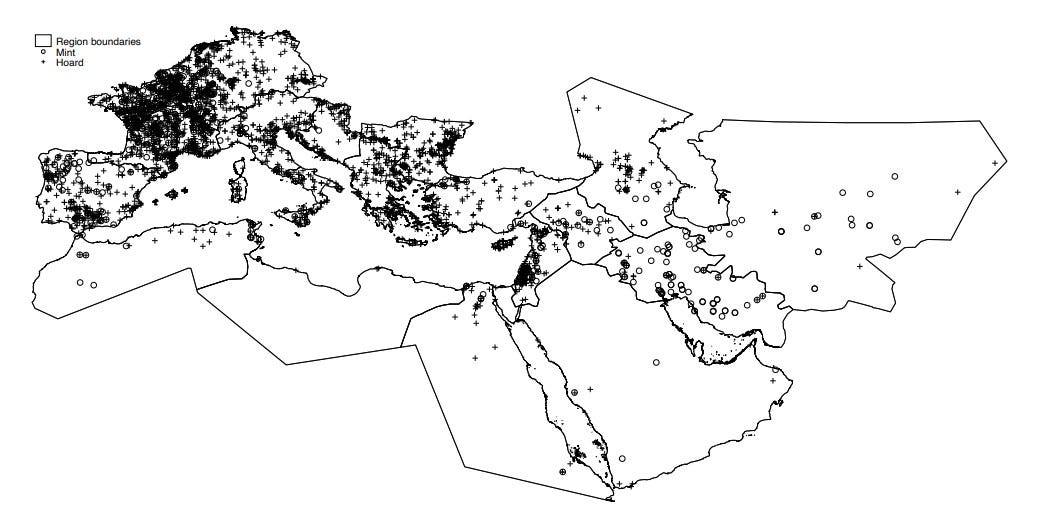
Throughout this period, mints across Europe and the Middle East continued to produce coins which traders transported across the continent. By following these coins, Boehm and Chaney could reconstruct trade routes.
Mints and hoards from late antiquity across Europe and the Middle East
Source: Boehm and Chaney (2026)
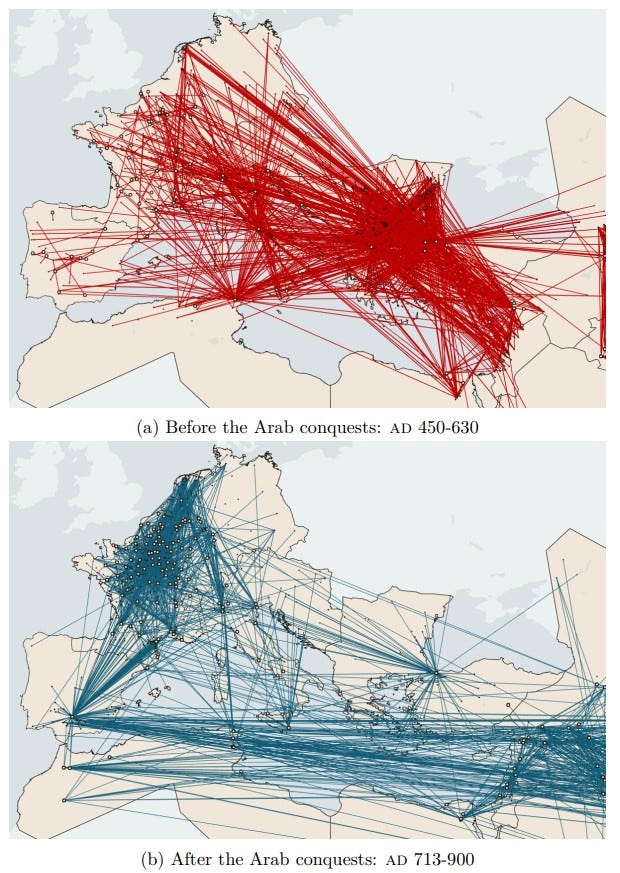
The maps below show how trade routes changed from late antiquity (450-630 CE) to the time after the Arab conquests (713-900 CE). Note how the Byzantine Empire in modern-day Turkey and southeast Europe was increasingly cut off from trade because there was now a border between the Christian and Muslim world that reduced trade flows. Meanwhile, trade flows to modern-day France and Germany increased via the Muslim trade routes in North Africa and into Spain.
Trade flows across Europe
Source: Boehm and Chaney (2026)
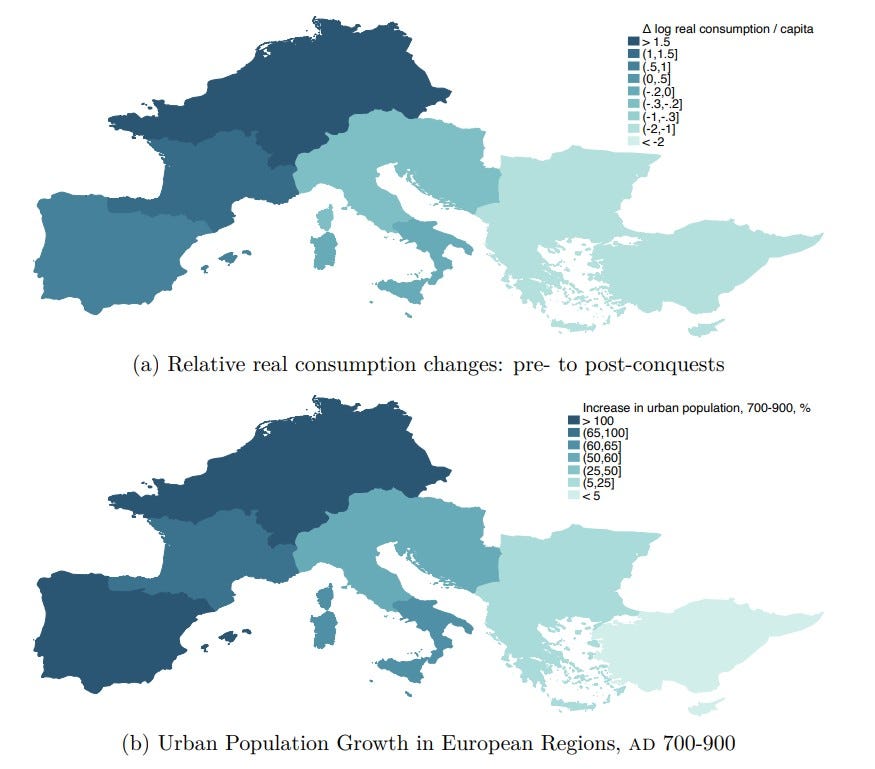
The final two maps show the impact this increased trade had on the different regions in Europe. The map on the top shows the change in consumption between the two periods. Dark and medium dark shades of blue imply growth in consumption (driven by rising wealth) while lighter shades imply declining consumption. Italy, the Balkans, and Turkey all got poorer, while France and Germany saw a rapid increase in consumption.
One thing that went hand-in-hand with this increase in wealth and consumption was urbanisation. The map on the bottom shows the growth in urban populations between 700 and 900 CE. Cities tend to be wealthier than rural regions because they act as trade hubs and benefit from network effects where new technologies (some of which are imported via trade or learned from other people via trade relations) can spread faster. These new technologies increase labour productivity, which in turn increases wealth and then consumption. It really is the same process today and the main reason why cities are generally wealthier and more productive than rural areas, even in the 21st century.
And of course, as modern-day France and Germany became richer, this increased the military might of Pippin and his son Charlemagne and gave rise to the dominance of the Carolingian Empire and indeed the Northern European region for the next 1,000 years and more.
So, if you live in Germany, France, the Netherlands, Belgium, or even the United Kingdom, you owe some gratitude to the Arabs conquering North Africa and Spain. Without them, we would probably be quite a bit poorer today compared to our neighbours in Southeast Europe and Turkey.
Change in consumption (top) and urbanisation (bottom)
Source: Boehm and Chaney (2026)
The urbanisation channel you describe is the one people still underestimate. Trade doesn't just move goods; it moves density, and density is what compounds productivity.
In my work with salaried professionals, the same pattern shows up at household level. Families that stay plugged into a high-density network keep upgrading their skills and earnings; the ones that retreat to a single employer in a single city plateau quietly.
Great idea to follow the coins. One thought on the hoards: people buried coins to keep them safe and usually dug them up again. The ones we find today are the ones nobody came back for, often because of war or flight. So the maps may partly show where the trouble was, not just where trade went. Does the paper deal with that?