

One of the eternal debates in the investment world is whether professional forecasters and investors are better at forecasting market and stock returns than individual investors and corporate executives. As a professional investor who used to work in private banking for a long time, I am pretty sure that most professionals are way better than most individual investors. But rarely have I found such a beautiful collection of charts to support this belief as in a paper by David Thesmar and Emil Verner.
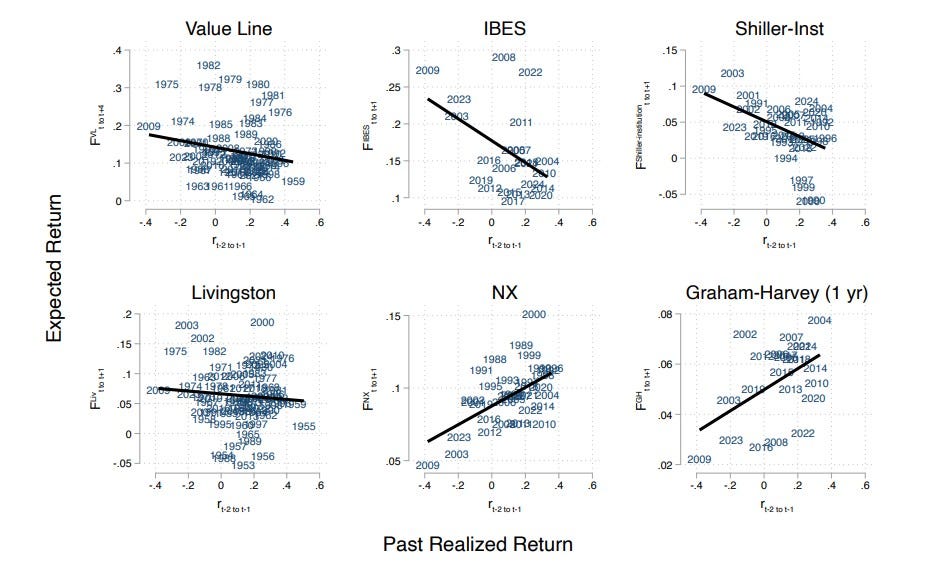
They collected a long time series of expected equity returns from a variety of surveys among a wide range of constituents. The collection of charts below shows the key result.
Past realised returns and subjective expected returns
Source: Thesmar and Verner (2026)
Each chart shows the relationship between past realised returns for the US stock market and expected returns of the survey respondents for the following year. In the top line, you have three surveys of professional investors. The Value Line survey of professional investors spans the longest time period, from 1956 to 2024. The IBES database is the regular survey of professional investors by Thomson Reuters, and the survey to the top right is the regular survey of professional investors by Prof. Robert Shiller.
All three surveys show the same pattern. Professional investors expect higher returns when past returns were lower and vice versa. This is the relationship that has been empirically verified millions of times in stock markets and lies at the heart of every valuation methodology known to man.
In the bottom row to the left, we see the relationship of professional economists surveyed in the Livingstone Survey by the Federal Reserve Bank of Philadelphia. Economists seem to have taken the legal disclaimer at the bottom of every investment presentation to heart: Past returns are no indication of the future. There is hardly any change in their return forecasts, regardless of past returns.
Finally, the charts on the bottom row, middle and right are surveys of individual investors (i.e. non-professionals by Nagel and Xu (NX) and surveys of company CFOs by Graham and Harvey. In both cases, we see clear evidence of trend-following behaviour, both individual investors and company CFOs think that future returns are going to be higher if past returns were higher.
Not ideal, particularly not if you are the CFO of a company and have to guide the market on the outlook of your business in the coming year…
This matches what I saw over a long career. Individuals and CFOs are most optimistic just when valuations say returns are likely to be lowest. The buyback data show it plainly: S&P 500 repurchases peaked in 2007 and collapsed in 2009, when shares were cheapest. Professionals tend to think in terms of valuation, while individuals and CFOs think in terms of momentum.
One nuance: The horizon matters. Over six to 12 months, momentum does have some predictive power, so the extrapolators (a.k.a. traders) aren't wrong in the short term. The mistake is to then apply a short-term signal to multi-year decisions such as cap ex and buybacks. That's where valuation wins.
And, having run a research department, I'd add that part of sell-side "mean reversion" is built into the measure. Price targets are sticky, so when a stock rallies, the implied upside shrinks automatically. Some of the contrarian result may be arithmetic rather than judgment.
When I was a sell-side analyst, an institutional salesperson once told me that a 12-month stock price target on a buy recommendation with 10% upside "wasn't enough", and a 30% or more upside target was "ludicrous"; so that's why most street upside targets are 20%. If the upside is anchored, the target does the moving, and the "mean reversion" comes with it.
but how does this help understand if professional forecasters do better than non-professional forecasters? high returns, and that's what we know form empirical research, do not necessarily forecast lower market returns - but valuation multiples do;
ps: i am definitely in the camp of arguing that markets can be forecasted, just to make this clear;