

The selection of management talent is one of the most critical tasks in a company. Pick an incompetent manager, and entire teams and divisions can start to underperform. Pick a talented one, and productivity and profits can rise dramatically. So, what is the criterion with which companies should select managers to have the best chance of success?
A team at the London School of Economics around Ben Weidmann tried to answer this question with the help of a lab experiment. They recruited 555 participants, measured key psychological traits like the Big Five personality traits or their intelligence. Then they formed teams with 12 to 18 people and promoted one team member to manager.
The teams then worked on group exercises that required numerical, spatial and analytical reasoning to answer a set of questions. The better the groups worked together, and the more efficiently people were allocated to different tasks and questions, the better the team would perform.
The trick? In half the cases, the manager was randomly chosen in a lottery; in the other half, the person who previously said they were eager to become a manager and thought of themselves as being a good manager was promoted (self-selection).
And you guessed it. The randomly chosen managers performed better than the self-selected ‘egotists’. Sorry, I meant ‘careerists’. Sorry, no, I meant ‘commercially-oriented individuals with a growth mindset’.
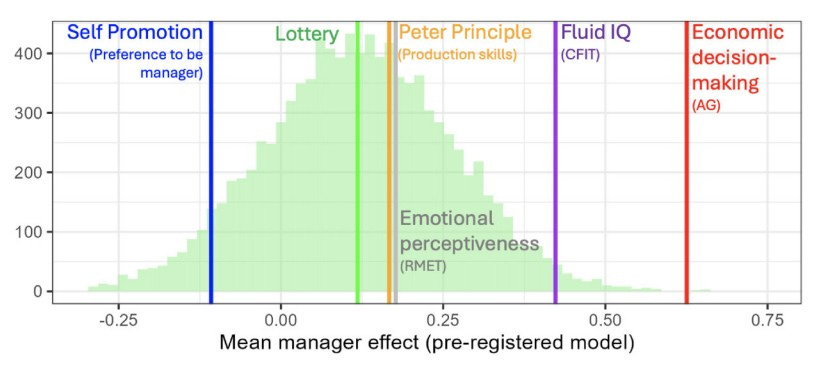
The chart below shows the resulting shift in team performance based on the selection criterion. The green distribution shows the effect of randomly chosen managers on the score of the group in the group task. The bright green vertical line is the average performance effect of the group of a randomly chosen manager. Compare that to the average performance of a group led by a self-selected manager. On average, the groups run by self-selected managers are worse than groups chosen by a randomly chosen manager.
What I like about that chart is that it also shows the impact of other criteria for choosing the manager of the group. The grey bar shows the average improvement in performance of groups managed by emotionally intelligent managers, while the orange line denotes the average improvement of the group if managers are chosen by the Peter Principle.
For those who don’t know, the Peter Principle is named after Prof. Laurence Peter, who described it in 1968. It is often summarised as ‘everyone is promoted to their individual level of incompetence’. Basically, if a person is competent in their job, they are likely to get a promotion and climb the career ladder. They continue to be promoted until they end up in a job where they fail because they do not have the competence to do it successfully. And then the promotions stop. But because companies don’t demote incompetent managers, these managers are then stuck in a job they can’t do forever, without any way out of their (and their team’s) misery.
As you can see in the chart, the Peter Principle works to an extent. It seems to be better than randomly choosing a manager and about as well as choosing the people who are emotionally intelligent. But what clearly works much better is simply promoting the people with the highest IQ (the purple line), and the best way to select managers is to focus on economic decision-making abilities, as shown in the red line.
But note that economic decision-making ability here does not mean thinking commercially and chasing revenues or profits. Rather, it means being able to allocate resources in the most efficient manner as described in a study by Andrew Caplin and others.
People who are able to look at the limited resources at their disposal and then allocate these resources most efficiently, delegating tasks to the person best able to deal with it productively, make for the best managers and create the highest-performing teams. It makes a lot of sense, if you think about it, but look around you at your workplace. And then tell me that in your firm people are promoted based on their ability to allocate resources the best…
Average change in group performance and manager selection criterion
Source: Weidmann et al. (2026)
Very valid, thanks for sharing. Buffett says the business should be able to be run by idiots. That is the other extreme, I think. The challenge for us is how to evaluate management without a long track record. The best proxy I have found is incentive alignment, check the company's proxy statement and see how correlated are the gains for managers and minority shareholders.
In banking the selection is in most cases: a popularity contest, networking (network-lick*ng), education with status (sometimes not even that), game of thrones, eliminating strong candidates before they are seen etc ... .
Skill and all is VERY secondary, sometimes it doesn’t matter at all (that is what ultra smart geeky experts are for, they suggest the best course, what would a smooth talker clown manager be able to say or do better? None, hence easily replaceable and should have 50%-80% less pay & bonus). But you know, they talk about ‘productivity, dedication, passion, engagement’ … sometimes it feels like a theatre play or a circus).
Just my experience and that of many friends and high level management consultants in European Banking (not that empirical, sample population, but real life).